Sunday, February 13, 2011

Self-Defense? Oh Yeah, It’s About Diet Soda (Is it?)


Did you, by chance, see the article on-line that reported a study about drinking diet soda? The report suggested that there was a 61% higher risk of vascular events (like strokes and heart attacks) for people who drank a diet soda every day.

Now whether that report is accurate or not is not the issue. What IS the issue is that your health is linked to what you (do or do not) consume. This is so important an aspect of self-defense that my colleagues and I have started a website called www.DietarySelfDefense.com. Nutritionist and black belt Mike Tubbs oversees the site --and loads plate-fulls of useful reminders and information there.

Food and nutrition information is finding its way into our schools and on to our mats too (not to mention, in our mouths!). It’s about time!

Self-defense training is so much more than learning how to handle yourself in a hand-to-hand combat situation. If self-defense (of any kind) is of interest to you, call us. We’re collecting stories, people, and ideas around the topic of, well, EVERYTHING Self-Defense.


Our contact information is Samurai Karate Studio, 803-462-9425, samuraikarate@bellsouth.net, 2000 Clemson Road, Suite # 9, Columbia, SC, 29229

Here’s the link to the story n diet soda:http://www.msnbc.msn.com/id/41479869/ns/health-diet_and_nutrition

Self-Defense is Found in the Simple Things

We teach self-defense --and self-defense is found in the simplest of things. Kindness, for example; kindness is a beautiful form of self-defense. Good food --and the appreciation of it; there’s a fine, fine kind of self-defense. Oh, and how about love of community? Participation in --and love for --one’s community is a kind of self-defense that’s impossible to put a value on. And my favorite kind of self-defense is found in a simple rule, The Golden Rule: Treat others as you would want them to treat you. Simply perfect.
We like Tom Callos’ (www.tomcallos.com) description of self-defense too: “Self-defense isn’t only about personal protection, it’s about taking care of the people around you, the town you live in, and allowing that care to radiate out in ever-widening circles.” And of course, self-defense training is all you already imagined it to be, but with this particular attitude about it, self-defense becomes about living a good life. What a great way to look at it! For information about our school and self-defense lessons for today’s world, contact us at 
Samurai Karate Studio
803-462-9425
samuraikarate@bellsouth.net
Columbia, SC 29229

Sunday, January 30, 2011

Mixed Martial Arts (MMA), Karate, Taekwondo, or Jiu-jitsu, which is Best?


This is an article full of shopping advice. If you’re shopping for a martial arts school, for training, then you’ve come to the right place. My friend and mentor, Tom Callos, shares his view of what the best style of art to train in:

"I’ve been studying the martial arts for 40 years, I’m a 6th degree black belt in taekwondo, a 17 year practitioner of Brazilian Jiu-jitsu, and my students have included national taekwondo champions, karate point-fighters, and mixed martial arts legends. So, when it comes to martial arts training, in every -- and any --realm, I know (exactly) what I’m talking about.

Here are three piece of advice for you, regardless of the kind of martial arts you might be interested in:

* It’s the coach, the teacher, that makes the “style,” not the other way around. Look for a coach you respect, look for a teacher you feel you have rapport with. If a martial arts teacher treats you poorly, leave. If he or she treats you with respect, you might be in the right place.


* Find a teacher that has a kind of training that speaks to the kind of training you like to do (or think you would like to do). If the class is too easy or too slow for you, say so. If it’s too hard core, consider finding another teacher (or at least address the issue with the instructor). Some teachers will use apparatus to train, some will only need mats or mirrors or a hardwood floor. If you have the luxury of choices, then choose a kind of training that fits your fitness level and interests.


* Every good school offers an introductory program that allows prospective students to try classes before they enroll. If a school does not offer a free trial class, don't enroll.

* Don’t sign any sort of long term contract for lessons with an instructor until you know him or her very, very well. If you know the teacher, go ahead and support them. If you don’t know the teacher, simply wait until you do. If a school owner tries to pressure you into a long term or high ticket contract, find somewhere else to spend your money.


In the end, in today’s world, most martial arts teach many of the same things. Remember however, it’s not “the martial art” that teaches you, it’s the teacher. Look to his or her experience and demeanor before you look at the style.

Advice for Men and Women over the age of 40, Thinking About Taking Martial Arts Classes


First, take it slow. No, really. There’s no hurry, it’s not a competition, and you’re not 20 anymore (even though you look like it). Going too hard, too fast, is why a lot of people who would like to enjoy all the benefits of training, no longer practice the martial arts (or any number of activities). Go too fast, get injured; get injured, quit training.

Second, if the instructor is your age (or older), that’s a good thing. If he or she is younger, make sure they know who’s the boss (you!). You only do what your body says you can do. If and when a class moves into an area you, for sure, want to avoid, you can always find an alternative way to stay engaged. What you shouldn’t do is “100 reps” when your body is telling you the 50 would be wise. Trust me, your teacher will appreciate your input. Give yourself enough time and you will not only keep up with the group, you might be leading it!

Be consistent. Being inconsistent about class attendance can dampen the fire of your enthusiasm. Stay on course!

Try out the class you’re interested, first, before enrolling. There’s nothing wrong with trying a week or even two weeks of classes with an instructor you’re interested in studying with. Most all schools will provide you with an introductory or trial course,(if you like classes, they’re going to know you for a long, long time). If a school doesn’t offer an introductory, it’s a red flag to enrollment.

By the way, mention this post and receive a free introductory course to our school, good for you and up to 5 family and/or friends.

Tom Callos, 51 years of age and a 40 year veteran of martial arts practice (see his bio at www.tomcallos.com) offer the following advice:

“Don’t hesitate to enroll in martial arts classes,” says Callos. “It’s a wonderful, thorough, and engaging form of exercise. Just be mindful about the way you practice. Study some of the history of the art you engage in. Enjoy the process of improvement.”

Tuesday, January 25, 2011

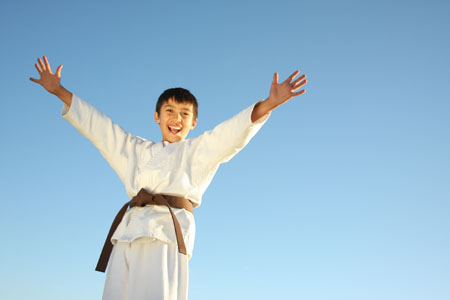
Mom, Dad, Here’s The Honest Truth About The Martial Arts for Your Child, Age 5 to 13.

By Tom Callos of www.TomCallos.com
 
 
I took my first martial arts lesson at age 9. By the age of 13, when my friends were experimenting, when peer pressure seemed at an all time high, when I just knew my brain power had far surpassed my father’s, and when I couldn’t pass any reflective surface without gazing in wonder at what it beheld, I was firmly and deeply entrenched in my identity as a martial artist.

The classes anchored me, in fact, they were just about the only place where I could stand completely still for any extended period of time (except, of course, if front of the TV).  The instructors emphasized respect, courtesy, and a code of honor that nobody else I knew seemed to care about. For me, that was good. It made me feel unique.

In a good martial arts school, your child will feel like a part of “the team.” And this team, if they’re good at what they do, will have daily talks about compassion, about respect for self and others, about kindness, and about non-violent conflict resolution.
 

 But equally as good as the philosophy can be is the fact that your little one will be training, as in legs flying, rolling, punching, blocking, jumping, and spinning. Each maneuver has an effect on your child’s brain and, of course, their body. When I watch the young people in my classes doing what we do, I always think about how good it is that they’re here, doing something so constructive and positive.

I also reflect back to when I was a child --and that’s usually followed by a silent “thank you” to my parents.

Football, soccer, baseball, tennis, and guitar were all fun, but not one of them affected me as my martial arts lessons have. If you’re a parent, I would highly recommend enrolling your child in a good school --and you might even consider some classes for yourself.
By the way, I'm 51 now --and the martial arts are STILL keeping me out of trouble.
I feel blessed to know Tom Callos.  He not only is my mentor, he is my friend!  He is an amazing person, who has over 40 years of training and teaching in the martial arts and he has such a unique vision of what the martial arts world should represent.    Sensei Chris Feldt


Sensei Chris Feldt
Samurai Karate Studio
803-462-9425
samuraikarate@bellsouth.net

Monday, January 24, 2011

10 Tips for Martial Arts Students, to Deepen Your Practice


You didn’t start your study of the martial arts to “go through the motions” of it all, did you? Of course you didn’t, but look around you in your next class and I’ll bet you spot a number of your classmates doing that very thing, going through the motions. It’s human nature to get distracted, to multi-task, and wander off course.

To deepen and strengthen your practice so that you stay on the mark and make reasonable progress, I offer you these 10 time-tested, Tom-tested tips:

1. As often as you can remember to do so, say to yourself “I am aware that I am training” (kicking, punching grappling, or whatever it is you’re doing at the moment). For me, that never fails to get my head out of the clouds and back into my practice (I am aware that I am writing this!).

2. Use a training partner (or partners) to hold you accountable to more intense, more focused, and more “present” practice. Friends are a good thing.

3. Eat better food before and after ever class (and, of course, that translates into ALL THE TIME). If you’re body’s jammed full of food-delivered chemicals, cups of corn-syrup, and crates full of unnecessary carbs or fats, you’re going to find you don’t function like the well-oiled machine you're supposed to be. Contrary to the way a lot of people live their lives, what you eat IS important to your performance. In fact, what you eat IS self-defense.

4. Breath deeply, focus on breathing deeply, think about breathing deeply, and maybe, if you have a habit of forgetting, write “BREATH DEEPLY” on the backside of your hand. To see just how much this helps you, do it. You’ll feel the benefits right away.


5. Take your practice off of the mat. Courtesy and respect for others isn’t something that’s practiced in the school with people you’re semi-afraid of. It’s for that ding-dong at the supermarket (you can tell what someone is made of by how they treat the people that mean nothing to them). It’s for your Mom, who sometimes bugs you in a big way. It’s for the substitute teacher (yes, even for him/her).

6. Practice at home, a minimum of 10 minutes a day on the days you don’t attend classes. Little things add up, so even 10 minutes of practice can help you grow. Oh, and if you don’t think 10 minutes matters, try to hold your side-kick out out for 10 minutes or try and hold your breath for 10 minutes. Yeah.

7. Read age-appropriate philosophy. Champions, whether in science, baseball, chess, jiu-jitsu, or cross-country skiing, all have belief systems that make them rise above hardship and overcome obstacles. They all learn to cope with defeat --and victory. Reading the words of someone with experience can be the next best thing to talking with them face-to-face.


8. Go crazy. Yes, act in a way that most people would consider very odd indeed. For example, when things start getting really hard, you pretend they’re getting easier. Crazy! When everyone else complains --and for good reasons too, you find the good in the situation and jump up to be the first person to turn whatever is wrong, right. Insane! When everyone else quits, you stick to it! You’re a nut!

Actually, you’re a martial artist.

9. Measure your own personal performance on a scale between 1 and 10, with “1” being your worst performance --and “10” being an all out, focused, beautiful-to-behold effort. Try to operate as close to level 10 as you can during your classes (whether you’re standing still or doing difficult maneuvers). And while you’re at it, try to LIVE at level 10, whenever possible. It’s a good thing.

10. I hate to drop this one on you last, as it’s a bit of a let-down after all this glorious focus on you and yours, but maybe the best way to deepen your own practice of the martial arts is to help other deepen theirs. Yes, that’s right, in the end, it’s not about you at all. Funny how it always works out that way.

By Tom Callos

About the Author: Tom Callos’ bio and project portfolio may be read at www.tomcallos.com

Sunday, January 23, 2011

What should you expect of a martial arts teacher?


Yes, what SHOULD you expect from a martial arts teacher?

You should expect --and get common courtesy, yes? Of course. You might even expect uncommon, beyond-the-norm courtesy I would think? After all, isn’t a good deal of the martial arts about learning and practicing respect?

You should expect the teacher to be in good --to excellent --physical shape. An exception to that rule might come from a teacher who has an unexpected health condition or who suffers as a result of a disabling accident. Stephen Hawking, for example, is still without question a brilliant theoretical physicist, despite his physical limitations. But, in most cases, your teacher should be an example of the benefits of the lifestyle that the martial arts promotes.

You should expect your teacher to be knowledgeable, beyond his or her art. It takes more than a knowledge of kicks, punches, grappling, or _________ (name any physical skill here), to be the kind of teacher one imagines a “Master” of the martial arts to be. It takes some life experience, some mistakes, some losses, and some mileage on one’s life odometer to accumulate a little "wisdom" (common sense).

In the group of instructors I am a part of, The One Hundred, each of us is listed on this site: www.flavors.me/masterteachers. Each member listed there maintains a “project portfolio,” a record of the things we have done --or are currently doing --that, as the head of the project, Tom Callos, says, “Shows how we take our martial arts out of the dojo and put it to work in the world.”

Some of The One Hundred members are new teachers, so their project portfolios are just getting started, while other teachers on the team are veterans of dozens of remarkable community-based projects.

“In the future, “says Tom Callos, “all martial arts teachers will be judged not only by their physical skills or experience, but by how they’ve applied their ‘mastery’ to things in the world that lives outside of their schools.”

One thing you should definitely expect from every cognizant martial arts teacher is a chance to try his or her classes before making any kind of commitment to attending regularly. Ask for an introductory course (we will provide you with one free of charge), to try a class before determining whether the school is a place you would like to spend time at.

If and when you’re ready, call, write, or stop by our location, here: Samurai Karate Studio, 803-462-9425, samuraikarate@bellsouth.net.